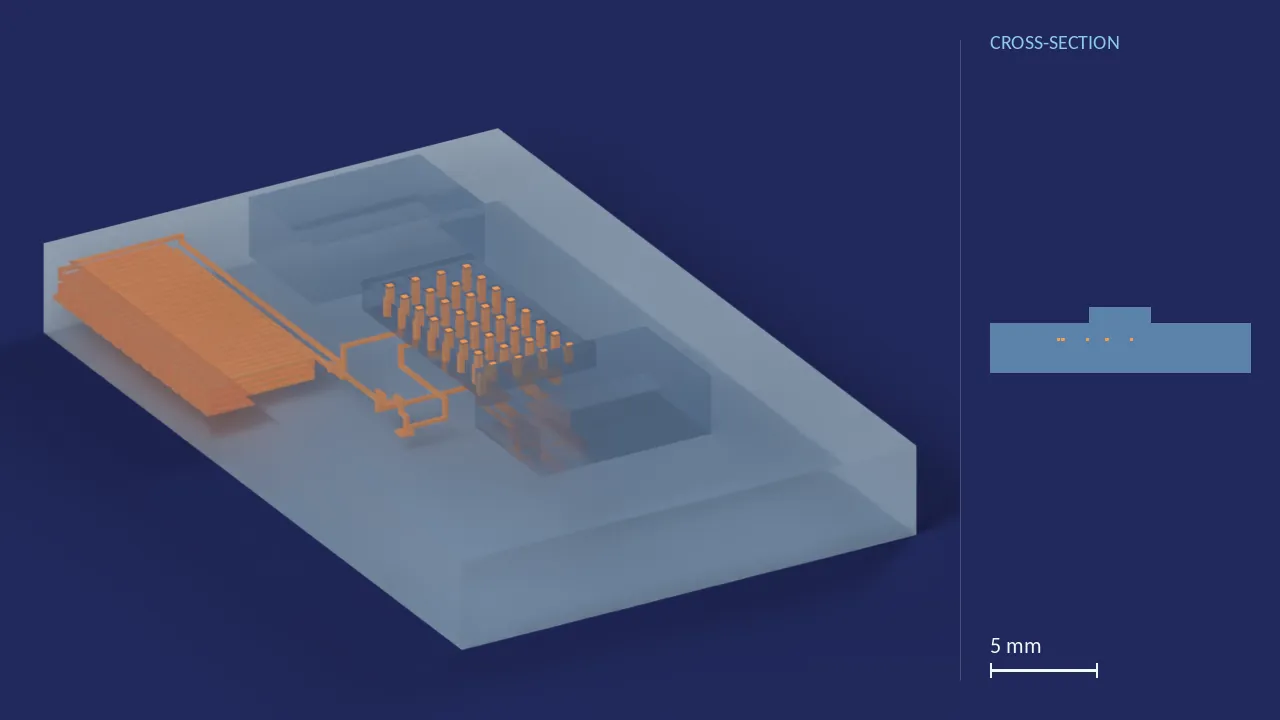
Geometry
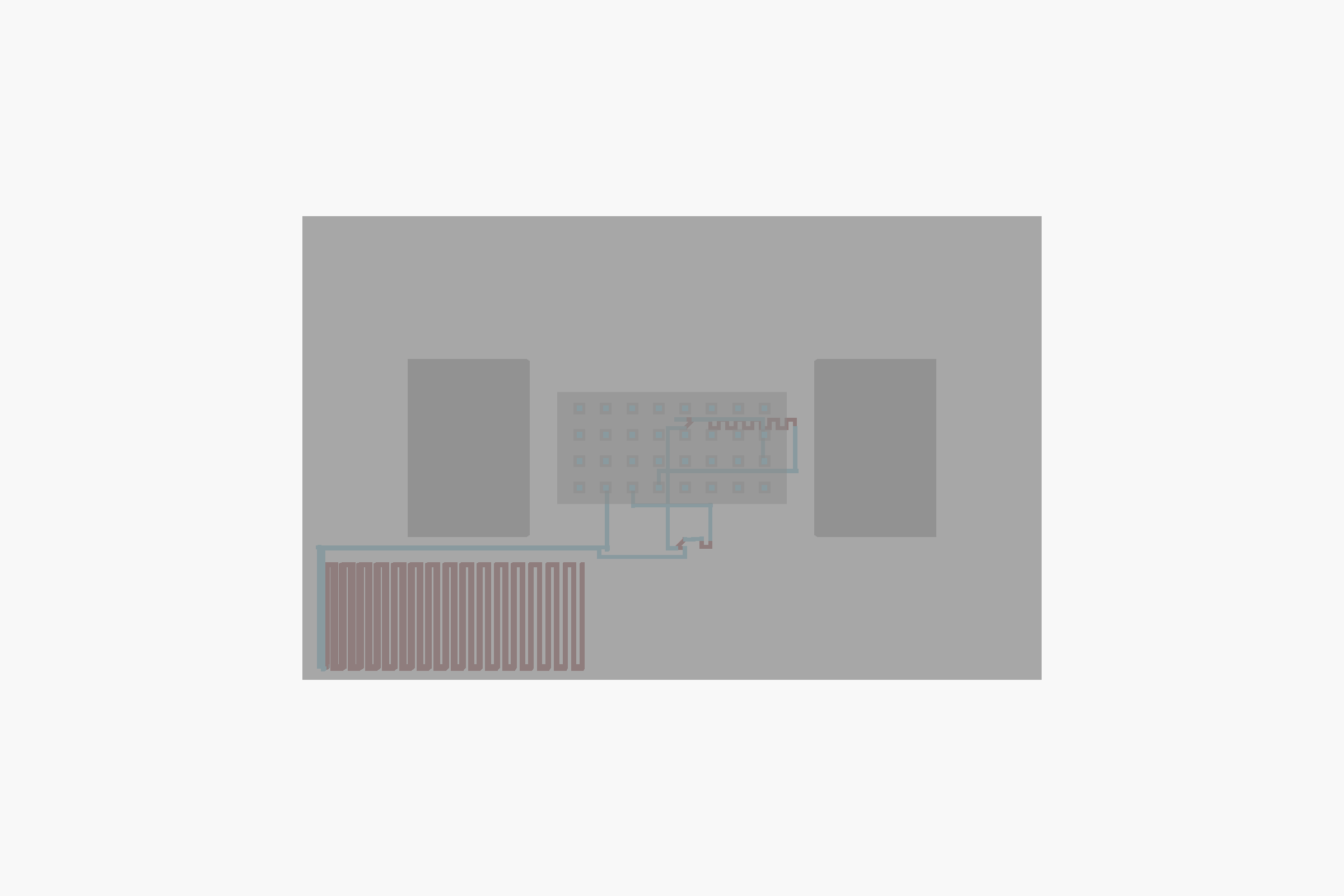
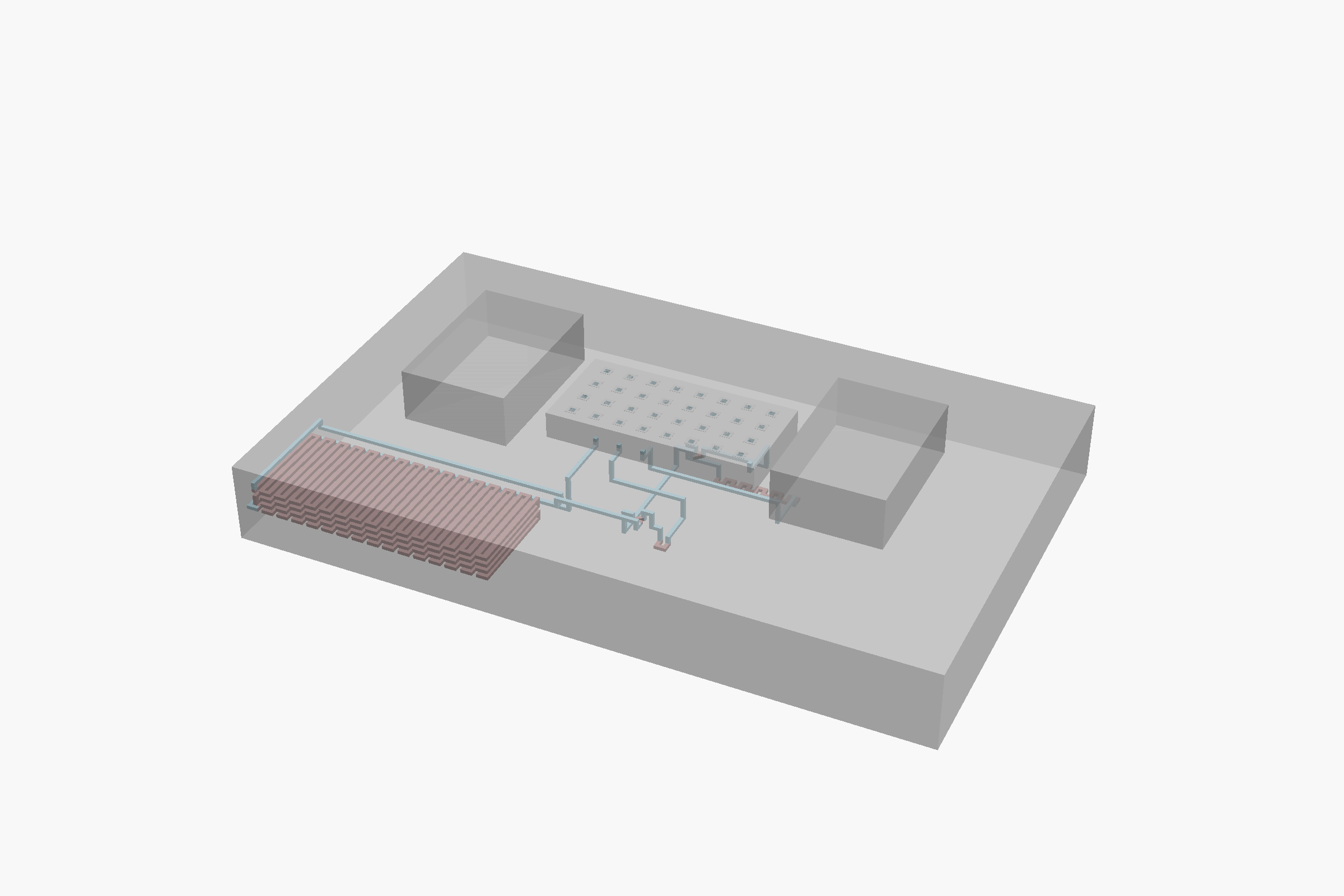
Top view (left) and isometric view (right) of the placed-and-routed chip. Rendered with OpenSCAD from the chip’s SCAD source, caffeine_reroute.scad. Click for high-resolution.
Download: PNG (top) · PNG (iso) · SCAD source ↓
Specifications
Assay
This chip is designed to measure urinary caffeine concentration via an enzymatic colorimetric assay. A caffeine-specific enzymatic reaction produces a coloured end-product whose absorbance correlates with the caffeine concentration in the sample.
Clinically, caffeine quantification supports metabolism studies, stimulant exposure monitoring, and pharmacokinetic research on caffeine clearance rates — relevant in research settings and in evaluating cytochrome P450 1A2 activity (caffeine is a canonical CYP1A2 substrate).
The chemistry is adapted from the Beckman Coulter AU480 reagent kit BAS6P419 (Caffeine). The chip combines the urine sample with two reagent streams at the volumetric ratios required by the assay protocol; the output collects the mixed product for off-chip spectrophotometric readout.
Files
- SCAD
caffeine_reroute.scad1.7 MBDownload - LEF
h.r.3.3_caffeine_pcells.lef1.9 KBDownload - CSV
pcell_out_scad204 BDownload - PNG
caffeine_iso_large.png85.1 KBDownload - PNG
caffeine_top_large.png18.2 KBDownload
caffeine_reroute.scad is the placed-and-routed 3D geometry — the main OpenSCAD source for this chip. h.r.3.3_caffeine_pcells.lef contains chip-specific cell abstracts. pcell_out_scad lists the parametric serpentine-channel variants this chip required (with L1 / L2 / turn count). The PNG renders are high-resolution versions of the views shown in the Geometry section above.
Papers
-
Related methodology archetype
Goenner, B., Temple, S., Zapata, S., Wakeham, D., Snelgrove, A., Gaillardon, P.-E., Nordin, G. P., & Gale, B. K. (2025). An open source platform to automate the design, verification, and manufacture of 3D printed microfluidic devices. Scientific Reports, 15, 33077. DOI: 10.1038/s41598-025-15976-9
Applications
For research use only. Not for use in diagnostic procedures.
A design for urinary caffeine quantification by an enzymatic colorimetric assay, the kind used in metabolism studies, stimulant exposure monitoring and research on caffeine clearance. One of the urinalysis chip designs in the Gale Lab urinalysis chip family (Erica Francis).